


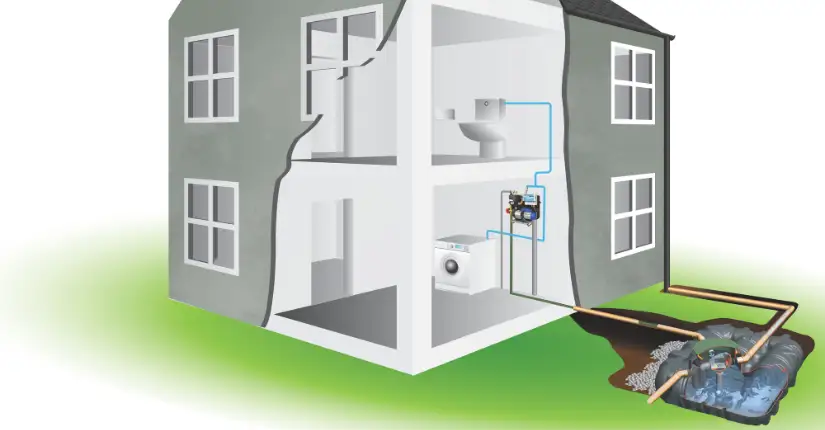
The GRAF AA system collects rainwater from your roof, filters it into an underground tank, and automatically supplies your toilets, washing machine, and garden. When the tank runs low, mains water feeds into a separate internal cistern rather than the tank, keeping every litre of storage reserved for rainwater.
If you’ve decided that rainwater harvesting is right for your self-build and you’re now comparing systems, understanding exactly how a system operates from start to finish is the most useful thing you can do before specifying. This post walks through the GRAF AA system step by step, from the moment rain falls on your roof to the moment it reaches your toilet, washing machine, or garden tap.
Why a step-by-step walkthrough matters when comparing rainwater harvesting systems
Most rainwater harvesting systems look similar on paper. They all collect from the roof, store in a tank, and supply non-potable uses in the home. The differences that matter, the ones that affect how much rainwater you actually collect and use over the lifetime of the system, are in the detail of how each stage works, and particularly in how the system manages the transition between rainwater and mains backup.
The GRAF AA system is designed around a single organising principle: mains water should never enter the underground tank. Every design decision in the system flows from that principle, and understanding why it matters is the key to comparing the AA range with other systems on the market.
Phase 1: Capture rainfall from the roof
Rainwater is collected from the roof and channelled through downpipes into the underground tank, passing through GRAF’s high-performance filters to remove leaves and debris.
Rainwater is collected from the roof surface via the existing guttering and directed to the system inlet pipe. The amount of rainwater a roof can collect depends on its surface area, pitch, and material, and on local annual rainfall. As a general guide, a roof of around 100 square metres in a typical UK location can collect in the region of 85,000 litres per year, though this varies by region and rainfall pattern.
The collection phase requires no active components. Rainwater flows under gravity from the roof to the inlet, making it the simplest and most reliable part of the system.
Phase 2: Keep the underground tank for rainwater only
The tank is reserved exclusively for rainwater. No mains water enters the tank, so 100% of the storage volume is available for harvested rainfall.
This is the principle that defines the AA system. Unlike direct rainwater harvesting systems, where mains backup water is introduced into the underground tank during dry spells, the AA system keeps the tank reserved exclusively for rainwater at all times. Before rainwater enters the tank, it passes through a high-performance inlet filter that removes leaves, debris, organic matter, and larger particulates, ensuring that what enters the tank is clean and suitable for the system’s intended uses.
The AA Eco-Plus uses GRAF’s standard inlet filter, which is self-cleaning and requires minimal maintenance. The AA Silentio adds a reversible flow filter at this stage, providing an additional level of filtration before the water reaches the tank.
Both filters are designed to maintain a water yield of over 95 percent, meaning that the vast majority of the rainwater that arrives at the inlet makes it through to the tank rather than being lost with the filtered debris.
A calmed inlet digester at the base of the tank ensures that filtered water enters gently, allowing very fine particles to settle at the base without disturbing the water already stored. This contributes to consistently good water quality throughout the tank.
Phase 3: Place the pump console where maintenance is easy
An external pump and control unit installed inside the property draws water from the tank as needed, using a floating intake to extract from the cleanest layer below the surface.
The pump and control unit installs inside the property, typically in a utility room or garage, where it is easily accessible for inspection without any groundworks. This is a deliberate design choice: keeping the active components of the system inside the property means maintenance is straightforward and accessible throughout the system’s life.
The pump draws water from the underground tank via a floating intake positioned just below the surface. This is the cleanest layer of water in the tank: sediment settles at the base, and any lighter particles accumulate at the surface. By drawing from neither extreme, the floating intake consistently delivers good-quality water to the pump without the need for additional treatment.
The control unit distributes water under pressure to the connected points of use: toilets, washing machines, and garden taps. The system operates automatically. When a toilet flushes or a washing machine begins a cycle, the pump activates and delivers rainwater from the tank. No manual intervention is required.
Tank sizes in the AA range run from 1,500 to 7,500 litres, and the right size for a given project depends on the roof catchment area and anticipated household demand.
Phase 4: Separate backup mains water in its own cistern
If stored rainwater runs low, the system automatically switches to mains water via the integrated cistern beneath the pump unit. Mains water feeds into the plumbing, not the tank.
This is the phase that distinguishes the AA system from most other rainwater harvesting systems on the market. When the water level in the underground tank drops below a set threshold, typically during extended dry spells, the system needs to draw on the mains supply to keep running.
In a direct rainwater harvesting system, mains water is introduced into the underground tank at this point. The tank tops up, the household continues to receive water, but the tank now contains mains water occupying storage space that could otherwise be reserved for rainwater. When rain returns, the tank can only collect up to its remaining unfilled capacity.
In the AA system, the mains backup takes a different route entirely. Rather than entering the underground tank, mains water feeds into the integrated cistern beneath the pump unit inside the property. The control unit draws from this cistern and continues to supply the household’s non-potable uses. The underground tank is left untouched.
This is the Type AA air gap in practice. Because the mains inlet and the underground tank are physically separated by the internal cistern, the two supplies never come into contact. This is a common compliance approach for high-risk non-potable systems under the Water Supply (Water Fittings) Regulations 1999, the level of backflow prevention required for systems supplying internal uses such as toilets and washing machines.
The AA Silentio’s digital display shows the homeowner the live water level in the underground tank at all times, making it easy to see when the system is drawing from the tank and when it has switched to mains backup.
Phase 5: Serve household demand with harvested water first
The system supplies toilets, washing machines, garden irrigation, and outdoor cleaning, all running on harvested rainwater rather than mains water.
When rain returns, collected rainwater begins flowing through the inlet filter and into the underground tank. Because the tank has not been topped up with mains water during the dry period, it is available at its full storage capacity to receive the incoming rainwater.
The system monitors the tank level continuously. As the tank refills, the control unit switches automatically from mains backup to rainwater supply. No manual intervention is required. From the household’s perspective, the transition is seamless: the taps, toilets, and washing machine continue to work exactly as they always have.
Over the course of a year, this cycle of collection, storage, use, backup, and refill repeats with each rainfall event. Because the underground tank is never occupied by mains water, each rainfall event has the full tank capacity available to it. This is the practical advantage of the AA system’s design: it preserves more capacity for rainwater collection, particularly after dry spells, compared to a system that introduces mains water into the tank.
How the AA Eco-Plus and AA Silentio compare
Both the AA Eco-Plus and the AA Silentio operate on the same five-phase principle. The core architecture, collection, filtration, storage, mains backup via the internal cistern, and refill, is identical. The differences are in three additional features on the Silentio.
The reversible flow filter provides an extra stage of filtration at the inlet, before water enters the tank. The digital display shows the live rainwater level in the tank, giving the homeowner clear visibility of how the system is performing. The automatic self-cleaning function on the filter, controlled by a timer, means the filter jet washes itself at set intervals without any action from the occupant.
For self-builders who want the core AA system at the most accessible price point, the Eco-Plus starts from £3,042.78 including VAT. For those who want greater visibility and lower maintenance requirements, the Silentio starts from £3,532.38 including VAT.
Both systems include free UK mainland delivery and are available in tanks from 1,500 to 7,500 litres, manufactured from 100 percent recycled plastic with a 15-year warranty.
Is the AA system right for your project?
If you’ve decided you want a rainwater harvesting system and you’re comparing options, the AA system is worth considering if you want to maximise how much rainwater your system actually collects and uses over time, and if you want a compliance-straightforward installation with a widely understood backflow prevention arrangement.
The tank size calculator at grafuk.co.uk gives you a system recommendation based on your roof area and household demand in around two minutes. That recommendation is the starting point for a full quote from the GRAF UK team with no obligation attached.
Posted by Callum Vallance-Poole, on May 4, 2026.